
OPTIMAL CONTROL MATHEMATICAL MODEL OF MALARIA AND TYPHOID FEVER CO-INFECTION DYNAMICS WITH ENVIRONMENTAL DEPENDENCY
DOI:
https://doi.org/10.60787/tnamp.v25.735Keywords:
Malaria- typhoid coinfection, Basic Reproduction Number, Optimal Control, Environmental dependency, Sensitivity analysisAbstract
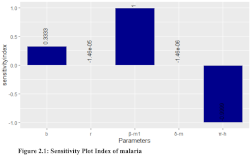
This study develops an optimal control mathematical model for malaria-typhoid co-infection dynamics with environmental dependency. The model incorporates, human populations, mosquito breeding vectors environments, Salmonella typhi bacteria reservoirs, and multiple control strategies within a unified framework. A system of nonlinear ordinary differential equations is used to describe the transmission dynamics. The Disease-free Equilibrium (DFE), Endemic Equilibrium Point (EEP), and basic reproduction numbers (????0) are derived and analysed. Stability analysis shows that DFE is locally asymptotically stable when ????0 < 1 and unstable when ????0 > 1. Sensitivity analysis identifies the key parameters that have the greatest influence on the disease transmission and persistence. Pontryagin’s Maximum Principle is applied to determine the optimal control strategies by minimizing the number of infected individuals, environmental reservoirs diseases, and the implementation costs of the control measures. Numerical simulations show that the combined implementation of treatment and environmental sanitation effectively reduces malaria-typhoid co-infection and disease burden. The findings emphasize the importance of integrating treatment with environmental management to support optimal and sustainable public health interventions for controlling malaria-typhoid co-infection and also provide useful insights for policymakers.
Downloads
References
Walairatana, P., Mala, W., Klangud, W. K., Rattaprasert, P., Kotepui, K. U., & Kotepui, M, (2021). Prevalence, proaility, and outcomes of typhoid/no-typhoidal Salmonella and malaria co-infection among feril patients: A systematic review and mete-analysis. Scietific Report, 11, 21889. https://doi.org/10.1038/s41598-021-00611-0
Centers for Disease Control and Prevention. (2017). Emerging infectious diseases: World malaria day. https://www.cdc.gov
Uyi-Osagie, Q., Oduwole, K.H., Umar, M. A., & Audu, A.M. (2025). Mathematical analysis of Malaria-typhoid co-infection dynamics with environmental drivers. Journal of the Nigeria Associations of Mathematical physics, 71, 57-72.
https://doi.org/10.60787/jnamp.vol71no.607
Awoke, T. D. (2019). Optimal strategy for the transmission dynamics of typhoid fever. America Journal of Applied Mathematics, 7(2), 37-48. .https://doi.org/10.11684/j.ajam.20190702.11
Matsebul a, L., & Nyabadza, F. (2022). Mathematical analysis of cholera-typhoid coinfection transmission dynamics. Frontiers in Applied Mathematics and Statistics, 8, 892098. https://doi.org/10.3389/fams.2022.892098
Zeleke, A. J., & Temesgen, T. (2021). Mathematical Modeling of Co-infection of Typhoid Fever and Plasmodium falciparum: IOSR Journal of Mathematics (IOSR-JM) e-issn: 2278-5728, ISSN:2319-765X. Volume 17, PP 35-56;
Burden, R. L., & Faires, J. D. (2016). Numerical analysis (10th ed.). Cengage Learning.
Alemneh, H. T., Kassa, A.S., & Godana, A. A. (2021). An optimal control model with cost effectiveness analysis of maize streak virus disease in maize plant. Infectious Disease, 6, 686-699. https://doi.org/10.1016/j.idm.2020.12.001
Sukhamoy, D., & Susmita, S. (2022). Mathematical modeling of infectious diseases. Infectious Disease Modeling, 7, 387–404.
Tilahun, G. T (2019), Optimal control analysis of pneumonia and meningitis coinfection. Computational and Mathematical Methods in Medicine,2017, Article 2658971.
Nyerere, N., Mpeshe, S. C., Ainea, N., Ayoade, A. A., & Mgandu, F. A. (2024). Global sensitivity analysis and optimal control of typhoid fever transmission dynamic:. Mathematical Modelling and Analysis, 29(1), 141-160.
Lawal, O. F., Yusuf, T. T., & Aidemi, A. (2024). On mathematical modelling of optimal control of typhoid fever with efficiency analysis. Journal of the Nigeria Society of Physical Sciences, 6(4), 2057. https://doi.org/10.46481/jsps.2024.2057
Arias-Castro, J. H., Martinez-Romero, H. J., & chemical control of mosquito population by optimal control approach. Games, 11(4), 62.
Richard, Q., Choisy, M., Lefevre, T., & Djidjou-Demasse, R. (2024). On the necessity of account for age structure in human malaria transmission modelling. Mathematical iosciences, 378, 109319
Downloads
Published
Issue
Section
License
Copyright (c) 2026 The Transactions of the Nigerian Association of Mathematical Physics

This work is licensed under a Creative Commons Attribution-NonCommercial 4.0 International License.