GEOPHYSICAL AND STATISTICAL ANALYSIS OF SOLAR WIND AND GEOMAGNETIC CONDITIONS DURING FAST-ESR ION-UPWELLING CONJUNCTIONS
DOI:
https://doi.org/10.60787/jnamp.vol73no.724Keywords:
ionosphere, ion upflow, geophysical conditions magnetosphereAbstract
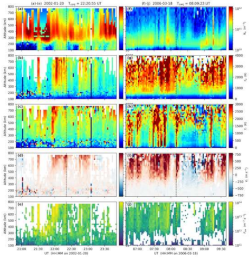
This study examines how solar wind and geomagnetic conditions drive heavy-ion outflow from the topside ionosphere, which influences atmospheric loss and magnetospheric dynamics. Using FAST satellite and EISCAT Svalbard Radar data during seven magnetic conjunction events with previously identified ion upwelling, the authors analyzed OMNI solar wind data and geomagnetic indices. Two representative events are highlighted: a nightside conjunction on 2002-01-20 during a substorm expansion phase with strongly southward IMF and AL exceeding -350 nT, and a dayside conjunction on 2006-03-18 during a corotating interaction region featuring variable solar wind and a two-step southward Bz turning. Across all events, 2006-03-18 showed the greatest solar wind variability and strongest dayside reconnection coupling, while 2005-09-12 exhibited the most solar wind–magnetosphere energy transfer in the sample. The findings are consistent with the established view that southward IMF and enhanced dynamic pressure promote ion energisation via reconnection-driven Joule heating and electron precipitation.
Downloads
References
Falthammar, C. (1986). Magnetosphere Ionosphere Interactions - Near-Earth Manifestations of the Plasma Universe. IEEE Transactions on Plasma Science, 14 616. https://doi.org/10.1109/tps.1986.4316613
Lakhina, G. S., Alex, S. and Rawat, R. (2009). An Overview of the Magnetosphere, Substorms and Geomagnetic Storms. Turbulence, Dynamos, Accretion Disks, Pulsars and Collective Plasma Processes, Astrophysics and Space Science Proceedings, Springer, Netherland 293.
Kivelson, M. G. and Russell, C. T. (1995). Introduction to Space Physics (First edition). United Kingdom,University of Cambridge: Cambridge University Press.
Gonzalez, W. D. and Tsurutani, B. T. (1987). Criteria of interplanetary parameters causing intense magnetic storms (Dst < −100 nT). Planetary and Space Science 35 1101.
David, T. W., Adekoya, B. J., Michael, C. M., Adekoya, S. A., Adenuga, O. A., Kareem,S. O., Oladunjoye, H. T., Ajetunmobi, A. E., Williams, O.T. and Ogundele, D. T. (2022). A Study of the Relationship Between Southward Bz > -10 nT and Storm Time Disturbance Index During Solar Cycle 23. Journal of the Nigerian Society of Physical Sciences 4(4) 620-627. https://doi.org/10.46481/jnsps.2022.620
Axford, W. I. and Hines, C. O. (1961). A unifying theory of high-latitude geophysical phenomena and geomagnetic storms. Canadian Journal of Physics 39 1433. https://doi.org/10.1139/p61-172
Yau, A.W., Shelley, E.G., Peterson, W.K. and Lenchyshyn, L. (1985). Energetic auroral and polar ion outflow at DE-1 altitudes - Magnitude, composition, magnetic activity dependence, and long-term variations. Journal of Geophysical Research 90 8417. https://doi.org/10.1029/ja090ia09p08417
Chappell, C.R., Giles, B.L., Moore, T.E., Delcourt, D.C., Craven, P.D. and Chandler, M.O. (2000). The adequacy of the ionospheric source in supplying magnetospheric plasma. Journal of Atmospheric and Solar-Terrestrial Physics 62 421. https://doi.org/10.1016/s1364-6826(00)00021-3
Hultqvist, B., Øieroset, M., Paschmann, G., and Treumann, R. A. (1999). Source processes in the highlatitude ionosphere. In Space sciences series of ISSI 7–84. https://doi.org/10.1007/978-94-011-4477-3_2
André, M. and Yau, A. (1997). Theories and observations of ion energization and outflow in the high latitude magnetosphere. Space Science Reviews 80(1-2) 27-48. https://doi.org/10.1007/978-94-009-0045-5_2
Shelley, E.G., Peterson, W.K., Ghielmetti, A.G. and Geiss, J. (1982). The polar ionosphere as a source of energetic magnetospheric plasma. Geophysical Research Letters 9(9) 941-944. https://doi.org/10.1029/gl009i009p00941
Dandouras, I. (2013). Detection of a plasmaspheric wind in the Earth's magnetosphere by the Cluster spacecraft. Annales Geophysicae 31(7) 1143-1153. https://doi.org/10.5194/angeo-31-1143-2013
Toledo-Redondo, S., André, M., Aunai, N., Chappell, C. R., Dargent, J., Fuselier, S. A., Glocer, A., Graham, D. B., Haaland, S., Hesse, M., Kistler, L. M., Lavraud, B., Li, W., Moore, T. E., Tenfjord, P. and Vines, S. K. (2021). Impacts of ionospheric ions on magnetic reconnection and Earth's magnetosphere dynamics. Reviews of Geophysics 59 e2020RG000707 https://doi.org/10.1029/2020RG000707
Wright, D. M., Davies, J. A. and Strangeway, R. J. (2012). Observations of ion outflows at high-latitudes derived from ground-based radar and spacecraft measurements. EGU General Assembly Conference Abstracts, Vienna, Austria, 6568. http://ui.adsabs.harvard.edu/abs/2012EGUGA..14.6568W/abstract
Strangeway, R.J., Ergun, R.E., Su, Y.J., Carlson, C.W. and Elphic, R.C. (2005). Factors controlling ionospheric outflows as observed at intermediate altitudes. Journal of Geophysical Research 110 A03221.
Ogawa, Y., Buchert, S.C., Fujii, R., Nozawa, S. and van Eyken, A.P. (2009). Characteristics of ion upflow and downflow observed with the European Incoherent Scatter Svalbard radar Journal of Geophysical Research 114 A05305. https://doi.org/10.1029/2008ja013817
David, T.W., Wright, D.M., Milan, S.E., Cowley, S.W.H., Davies, J.A. and McCrea, I. (2018). A study of observations of ionospheric upwelling made by the EISCAT Svalbard Radar during the International Polar Year campaign of 2007. Journal of Geophysical Research: Space Physics 123 2192-2203. htps://doi.org/10.1002/2017JA024802
Glocer, A., Toth, G., and Fok, M.-C. (2018). Including kinetic ion effects in the coupled global ionospheric outflow solution. Journal of Geophysical Research: Space Physics 123 2851-2871. https://doi.org/10.1002/2018JA025241
Glocer, A., Collinson, G., Garcia-Sage, K., Welling, D., Chappell, C., Rowland, D., Varney, R., Ilie, R. and Kistler, L. (2023). The Outflow and Recirculation of Ionospheric Plasma. Bulletin of the American Astronomical Society 55 130. https://doi.org/10.3847/25c2cfeb.a1163052
Howarth, A. and Yau, A. W. (2008). The effects of IMF and convection on thermal ion outflow in magnetosphere-ionosphere coupling Journal of Atmospheric and Solar-Terrestrial Physics 70 2132. https://doi.org/10.1016/j.jastp.2008.08.008
Wahlund, J. E. and Opgenoorth, H. J. (1989). EISCAT Observations of Strong Ion Outflows from the Fregion ionosphere during auroral activity – Preliminary results. Geophysical Research Letters, 16(7) 727-730 https://doi.org/10.1029/GL016i007p00727
David, T. W., Michael, C. M., Awoyinka, T. D., Ajetunmobi, A. E. and Talabi, A. T. (2024). Energetic Ionospheric upwelling: A Case Study of Velocity Distribution and Ion Flux Observed by the EISCAT Svalbard Radar. International Journal of Energetica 9, 48-53 http://dx.doi.org/10.47238/ijeca.v9i2.252
David, T. W. (2013). Investigation into Quiet and Magnetic Storms Periods Above Magadan During October - December, 2003. Indian Journal of Radio & Space Physics 42 89-96 https://nopr.niscpr.res.in/handle/123456789/17094
David, T. W., Akintola, A. N. and Adekoya, B. J. (2011). Time/Level of Ionospheric Response to Geomagnetic Storm of 25-26 July 1981 at Different Latitudes. Indian Journal of Radio & Space Physics 40 311-319 https://nopr.niscpr.res.in/handle/123456789/13318
David, T. W. and Chukwuma, V. U. (2012). Response of Ionospheric foF2 over South East Asian Sector to Geomagnetic Storm of 29 October 1973 Indian Journal of Radio & Space Physics 41 332-338 https://nopr.niscpr.res.in/handle/123456789/14371
Foster, C., Lester, M. and Davies, J.A. (1998). A statistical study of diurnal, seasonal and solar cycle variations of F-region and topside auroral upflows observed by EISCAT between 1984 and 1996. Annales Geophysicae 16 1144-1158 https://doi.org/10.1007/s00585-998-1144-0
Lockwood, M. and Cowley, S. W. H. (1992). Ionospheric convection and the substorm cycle, SUBSTORMS 1: Proceedings of the International Conference on Substorms, 23-27 March, 1992 https://centaur.reading.ac.uk/38835/
Danilov, A. (2001). F2-region response to geomagnetic disturbances. Journal of Atmospheric and SolarTerrestrial Physics 63 441-449 https://doi.org/10.1016/s1364-6826(00)00175-9
Liu, J., Zhao, B. and Liu, L. (2010). Time delay and duration of ionospheric total electron content responses to geomagnetic disturbances. Annales Geophysicae 28 795-805 (2010). https://doi.org/10.5194/angeo-28-795-2010
Milan, S. E., Gosling, J. S. and Hubert, B. (2012). Relationship between interplanetary parameters and the magnetopause reconnection rate quantified from observations of the expanding polar cap. Journal of Geophysical Research: Space Physics 117 A03226 https://doi.org/10.1029/2011ja017082
David, T. W., Adetunji, E. O., Michael, C. M., Wright, D. M., Talabi, A. T., & Ajetunmobi, A. E. (2025). Upwelling Ion Observation from the Earth’s Upper Atmosphere During EISCAT Svalbard Radar and FAST Satellite Conjunctions. Nigerian Journal of Physics, 34(4) 1-13.
Downloads
Published
Issue
Section
License
Copyright (c) 2026 The Journals of the Nigerian Association of Mathematical Physics

This work is licensed under a Creative Commons Attribution-NonCommercial-ShareAlike 4.0 International License.