INFLUENCE OF SPIN MAGNITUDE AND ORIENTATION ON GRAVITATIONAL-WAVEFORM MORPHOLOGY AND DETECTABILITY IN PRECESSING BINARY BLACK HOLES
DOI:
https://doi.org/10.60787/jnamp.vol73no.736Keywords:
Gravitational waves, binary black holes, Einstein Toolkit, spin precession, waveform morphologyAbstract
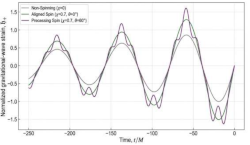
Spin-orbit misalignment in binary black hole (BBH) systems induces orbital precession, producing amplitude and phase modulations in gravitationalwave (GW) signals that affect waveform modelling and signal recovery. This study investigates the influence of spin magnitude (????) and spin tilt angle (????) on gravitational-wave morphology and matched-filter detectability using numerical relativity simulations performed with the Einstein Toolkit. Equalmass BBH systems (???? = 60 ????⊙) were simulated for spin magnitudes ???? = 0.0, 0.3, 0.7,and 0.9, and tilt angles of 0 ∘ , 30∘ , 60∘ ,and 90∘ . Increasing spin-orbit misalignment produced stronger amplitude and phase modulations, while larger spin magnitudes resulted in more pronounced orbital precession. The relative matched-filter signal-to-noise ratio decreased by up to approximately 16% compared with the aligned-spin configuration. These findings highlight the importance of incorporating spin precession into waveform models to improve gravitational-wave searches and parameter estimation.
Downloads
References
Abbott, B. P., Abbott, R., Abbott, T. D., Abernathy, M. R., Acernese, F., Ackley, K., ... & Cavalieri, R. (2016). Observation of gravitational waves from a binary black hole merger. Physical review letters, 116(6), 061102.
Apostolatos, T. A., Cutler, C., Sussman, G. J., & Thorne, K. S. (1994). Spin-induced orbital precession and its modulation of the gravitational waveforms from merging binaries. Physical Review D, 49(12), 6274-6297.
Baumgarte, T. W., & Shapiro, S. L. (1998). Numerical integration of Einstein’s field equations. Physical Review D, 59(2), 024007.
Bowen, J. M., & York Jr, J. W. (1980). Time-asymmetric initial data for black holes and black-hole collisions. Physical Review D, 21(8), 2047.
Boyle, M., Hemberger, D., Iozzo, D. A., Lovelace, G., Ossokine, S., Pfeiffer, H. P., ... & Walker, M. (2019). The SXS Collaboration catalog of binary black hole simulations. Classical and Quantum Gravity, 36(19), 195006.
Caprini, C., Pujolas, O., Quelquejay-Leclere, H., Rompineve, F., & Steer, D. A. (2025). Primordial gravitational wave backgrounds from phase transitions with next generation ground-based detectors. Classical and Quantum Gravity, 42(4), 045015.
Chandramouli, R. S., Prokup, K., Berti, E., & Yunes, N. (2025). Systematic biases due to waveform mismodeling in parametrized post-Einsteinian tests of general relativity: The impact of neglecting spin precession and higher modes. Physical Review D, 111(4), 044026.
Choustikov, N. (2020). The Einstein Toolkit: A Student's Guide. arXiv preprint arXiv:2011.13314.
Cutler, C., & Flanagan, E. E. (1994). Gravitational waves from merging compact binaries: How accurately can one extract the binary’s parameters from the inspiral waveform? Physical Review D, 49(6), 2658.
Fishbach, M. (2024). Mystery in the “mass gap”. Science, 383(6680), 259-260.
Gerosa, D., Kesden, M., O’Shaughnessy, R., Klein, A., Berti, E., Sperhake, U., & Trifirò, D. (2015). Precessional instability in binary black holes with aligned spins. Physical Review Letters, 115(14), 141102.
Goldberg, J. N., MacFarlane, A. J., Newman, E. T., Rohrlich, F., & Sudarshan, E. G. (1967). Spin‐s spherical harmonics and ð. Journal of Mathematical Physics, 8(11), 2155-2161.
Hanna, C., Kennington, J., Niu, W., Sakon, S., Singh, D., Adhicary, S., ... & Zhang, N. (2025). Template bank for subsolar mass compact binary mergers in the fourth observing run of Advanced LIGO, Advanced Virgo, and KAGRA. Physical Review D, 112(4), 044013.
Kidder, L. E. (1995). Coalescing binary systems of compact objects to (post) 5/2-Newtonian order. V. Spin effects. Physical Review D, 52(2), 821.
Löffler, F., Faber, J., Bentivegna, E., Bode, T., Diener, P., Haas, R., ... & Laguna, P. (2012). The Einstein Toolkit: a community computational infrastructure for relativistic astrophysics. Classical and Quantum Gravity, 29(11), 115001.
Mac Uilliam, J., Akcay, S., & Thompson, J. E. (2024). Survey of four precessing waveform models for binary black hole systems. Physical Review D, 109(8), 084077.
Mastrogiovanni, S., Karathanasis, C., Gair, J., Ashton, G., Rinaldi, S., Huang, H. Y., & Dalya, G. (2024). Cosmology with gravitational waves: a review. Annalen der Physik, 536(2), 2200180.
Mehta, A. K., Buonanno, A., Cotesta, R., Ghosh, A., Sennett, N., & Steinhoff, J. (2023). Tests of general relativity with gravitational-wave observations using a flexible theory-independent method. Physical Review D, 107(4), 044020.
Newman, E., & Penrose, R. (1962). An approach to gravitational radiation by a method of spin coefficients. Journal of Mathematical Physics, 3(3), 566-578.
Phurailatpam, H., More, A., Narola, H., Yin, N. C., Janquart, J., Broeck, C. V. D., ... & Keitel, D. (2024). ler: LVK (LIGO-Virgo-KAGRA collaboration) event (compact-binary mergers) rate calculator and simulator. arXiv preprint arXiv:2407.07526.
Pratten, G., García-Quirós, C., Colleoni, M., Ramos-Buades, A., Estellés, H., Mateu-Lucena, M., ... &
Husa, S. (2021). Computationally efficient models for the dominant and subdominant harmonic modes of
precessing binary black holes. Physical Review D, 103(10), 104056.
Ray, A., Hernandez, I. M., Mohite, S., Creighton, J., & Kapadia, S. (2023). Nonparametric inference of the population of compact binaries from gravitational-wave observations using binned gaussian processes. The Astrophysical Journal, 957(1), 37.
Sakon, S., Tsukada, L., Fong, H., Kennington, J., Niu, W., Hanna, C., ... & Wang, J. (2024). Template bank for compact binary mergers in the fourth observing run of Advanced LIGO, Advanced Virgo, and KAGRA. Physical Review D, 109(4), 044066.
Schmidt, S., Caudill, S., Creighton, J. D., Tsukada, L., Doke, A., Jain, M., ... & Wade, M. (2024). Searching for asymmetric and heavily precessing binary black holes in the gravitational wave data from the LIGO third observing run. Physical review letters, 133(20), 201401.
Shibata, M., & Nakamura, T. (1995). Evolution of three-dimensional gravitational waves: Harmonic slicing case. Physical Review D, 52(10), 5428.
Varma, V., Field, S. E., Scheel, M. A., Blackman, J., Gerosa, D., Stein, L. C., ... & Pfeiffer, H. P. (2019). Surrogate models for precessing binary black hole simulations with unequal masses. Physical Review Research, 1(3), 033015.
Yu, H., Roulet, J., Venumadhav, T., Zackay, B., & Zaldarriaga, M. (2023). Accurate and efficient waveform model for precessing binary black holes. Physical Review D, 108(6), 064059.
Bozzola, G. Kuibit: Analyzing and visualizing numerical relativity simulations with Python. Journal of Open- source Software, 6(63), 3099 (2021). https://doi.org/10.21105/joss.03099
Pfeiffer, H. P., Brown, D. A., Kidder, L. E., Lindblom, L., Lovelace, G., Scheel, M. A., & Teukolsky, S. A. (2007). Reducing orbital eccentricity in binary black hole simulations. Physical Review D, 76(8), 084016. https://doi.org/10.1103/PhysRevD.76.084016
Downloads
Published
Issue
Section
License
Copyright (c) 2026 The Journals of the Nigerian Association of Mathematical Physics

This work is licensed under a Creative Commons Attribution-NonCommercial-ShareAlike 4.0 International License.