EFFECT OF DIMENSIONALITY ON THE GROUND STATE PROPERTIES OF THE EXTENDED HUBBARD MODEL USING THE HIGHLY SIMPLIFIED CORRELATED VARIATIONAL APPROACH
DOI:
https://doi.org/10.60787/jnamp.vol73no.741Keywords:
Extended Hubbard model, highly simplified correlated variational approach, dimensionality effect, singlet-triplet energy gapAbstract
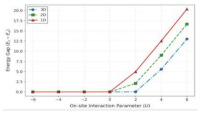
The extended Hubbard model (EHM) captures essential interactions (U, V, J) in strongly correlated electron systems, yet unified variational studies of spatial dimensionality effects remain sparse. Using the Highly Simplified Correlated Variational Approach (HSCVA), we investigate 24-site setups in 1D, 2D and 3D lattice with preserved coordination numbers z = 2, 4, 6. We compute the singlettriplet energy gap ( ) and critical exchange coupling (Jc) across U and V. The V = 0 singlet-triplet transition is universal across dimensions. For repulsive V/2t, the gap becomes negative ( ), signaling triplet ground-state stability with saturation values scaling by coordination number: -4.20 (1D), -8.00 (2D) and -15.99 (3D). Critical coupling Jc exhibits linear antisymmetric scaling in 1D and 2D, while 3D systems show non-linear growth for U > 0. These results provide quantitative benchmarks for dimensional crossovers in correlated systems.
Downloads
References
Imada, M., Fujimori, A., &Tokura, Y. (1998). Metal-insulator transitions. Rev. Mod. Phys., 70(4), 1039.
Dagotto, E. (1994). Correlated electrons in high-temperature superconductors. Rev. Mod. Phys., 66(3),
Lee, P. A., Nagaosa, N., & Wen, X. G. (2006). Doping a Mott insulator: Physics of high-temperature
superconductivity. Rev. Mod. Phys., 78(1), 17-85.
Khomskii, D. I. (2014). Transition metal compounds. Cambridge University Press.
Hubbard, J. (1963). Electron correlations in narrow energy bands. Proc. R. Soc. London A, 276(1365),
-257.
Gutzwiller, M. C. (1963). Effect of correlation on the ferromagnetism of transition metals. Phys. Rev.
Lett., 10(5), 159.
Kanamori, J. (1963). Electron correlation and ferromagnetism of transition metals. Prog. Theor. Phys.,
(3), 275-289.
Anderson, P. W. (1987). The resonating valence bond state in La2CuO4 and superconductivity. Science,
(4793), 1196-1198.
Scalapino, D. J. (2012). A common thread: The pairing interaction for unconventional
superconductors. Rev. Mod. Phys., 84(4), 1383-1417.
Liu, W. Y., Zhai, H., Peng, R., Gu, Z. C., & Chan, G. K. L. (2025). Accurate simulation of the Hubbard
model with finite fermionic projected entangled pair states. Phys. Rev. Lett., 134(25), 256502.
Akpojotor, G. E. (2014). Many electrons highly simplified correlated variational approach to Mott
insulator state at half-filling. J. Nig. Assoc. Math. Phys., 26, 137-146. See also Akpojotor, G., Echenim,
M. W., & Akpojotor, F. (2018). A simple computational tool to investigate strongly correlated system.
In APS March Meeting Abstracts (Vol. 2018, pp. E44-007).
Chen, Q., & Mei, W. N. (1996). Correlated variational approach for two-electron systems. Phys. Rev.
B, 54(19), 13873-13880.
Akpojotor, G. E. (2008) The statistical equivalents of the t-U and t-t'-U models (Part II: Participants’
Contributions) in Lectures on the Physics of Strongly Correlated Systems XII: Twelfth Training
Course held at Vietri sul Mare, Italy (edited by A. Avella and F. Mancini), AIP Con. Proc. 1014, 251
-259.
Enaibe, E. A., Akpojotor, G. E., Aghemenloh, E., Fiase, J. O., &Idiodi, J. O. (2004). On strongly
correlated N-electron systems. J. Nig. Assoc. Math. Phys., 8, 337-340.
Akpojotor Godfrey E. and. Akpojotor Famous A (2009) A highly simplified correlated variational
study of the singlet-triplet transition in quantum dots embedded in kagome lattice. Proceedings of the
Joint Conference of the National Society of Black Physicists and the National Society of Hispanic
Physicists (Washington DC, USA) American Institute of Physics (AIP) Con. Proc. 1040, 54-59.
Akpojotor, G. E. (2008). Possible propagation of the Zhang-Rice singlet as a probable Cooper channel
in the CuO2 planes. Phys. Lett. A, 372(46), 6992-6995.
Micnas, R., Ranninger, J., &Robaszkiewicz, S. (1990). Superconductivity in narrow-band systems
with local nonretarded attractive interactions. Rev. Mod. Phys., 62(1), 113.
Gebhard, F. (2000). Metal-insulator transitions. In The Mott Metal-Insulator Transition: Models and
Methods (pp. 1-48). Springer.
Xiao, B., Hébert, F., Batrouni, G., & Scalettar, R. T. (2019). Competition between phase separation
and spin density wave or charge density wave order: Role of long-range interactions. Physical Review
B, 99(20), 205145.
Qu, D. W., Chen, B. B., Jiang, H. C., Wang, Y., & Li, W. (2022). Spin-triplet pairing induced by nearneighbor attraction in the extended Hubbard model for cuprate chain. Communications Physics, 5(1), 257.
Alekseev, A., & Kapcia, K. J. (2026). Charge-ordered states and the phase diagram of the extended
Hubbard model on the Bethe lattice. Physica A, 131520.
Song, Z., Seifert, U. F., Balents, L., & Jiang, H. C. (2025). Emergent magnetism and spin liquids in an
extended Hubbard description of moiré bilayers. arXiv:2505.06339.
Scalapino, D. J. (1993). dx2−y2 Pairing in the cuprates? J. Phys. Chem. Solids, 54(10), 1433-1437.
Aichhorn, M., Evertz, H. G., von der Linden, W., & Potthoff, M. (2004). Charge ordering in extended
Hubbard models: Variational cluster approach. Phys. Rev. B, 70(23), 235107.
Davoudi, B., & Tremblay, A. M. (2007). Non-perturbative treatment of charge and spin fluctuations
in the two-dimensional extended Hubbard model: Extended two-particle self-consistent
approach. Phys. Rev. B, 76(8), 085115.
Benthien, H., &Jeckelmann, E. (2007). Spin and charge dynamics of the one-dimensional extended
Hubbard model. Phys. Rev. B, 75(20), 205128.
Qin, M., Shi, H., & Zhang, S. (2016). Benchmark study of the two-dimensional Hubbard model with
auxiliary-field quantum Monte Carlo method. Phys. Rev. B, 94(8), 085103.
LeBlanc, J. P., Antipov, A. E., Becca, F., Bulik, I. W., Chan, G. K. L., Chung, C. M., & (Simons
Collaboration on the Many-Electron Problem). (2015). Solutions of the two-dimensional Hubbard
model: Benchmarks and results from a wide range of numerical algorithms. Phys. Rev. X, 5(4), 041041.
Giamarchi, T. (2004). Quantum physics in one dimension. Oxford University Press.
Essler, F. H., Frahm, H., Göhmann, F., Klümper, A., &Korepin, V. E. (2005). The one-dimensional
Hubbard model. Cambridge University Press.
Fradkin, E. (2013). Field theories of condensed matter physics. Cambridge University Press.
Proust, C., &Taillefer, L. (2019). The remarkable underlying ground states of cuprate
superconductors. Annu. Rev. Condens. Matter Phys., 10(1), 409-429.
Ashcroft, N. W., & Mermin, N. D. (1976). Solid state physics. Holt, Rinehart and Winston.
Georges, A., Kotliar, G., Krauth, W., &Rozenberg, M. J. (1996). Dynamical mean-field theory of
strongly correlated fermion systems and the limit of infinite dimensions. Rev. Mod. Phys., 68(1), 13.
Kotliar, G., &Vollhardt, D. (2004). Strongly correlated materials: Insights from dynamical mean-field
theory. Phys. Today, 57(3), 53-59.
Chen, W. C., Wang, Y., & Chen, C. C. (2023). Superconducting phases of the square-lattice extended
Hubbard model. Physical Review B, 108(6), 064514.
Becca, F., & Sorella, S. (2017). Quantum Monte Carlo approaches for correlated systems. Cambridge
University Press.
Akpojotor, G., & Ehwerhemuepha, L. (2012). An overview of the Python African Computational
Science and Engineering Tour Project. Invited Talk at PyCon US 2012 held at Silicon Valley-Santa
Clara, California (USA) from March 7th-15th, 2012. Retrieved from http://pyvideo.org/video/738/25-an-overview-of-the-python-african-computation. See also Akpojotor, G. (2014). Overview of the
Python African Computational Science and Engineering Tour Project. 36th, 103.
Omoriwhovo, J. O., Agbajor, G. K., Akpolilie, A. L., & Akpojotor, G. (2022). Python AIM solver to
obtain vibrational energy spectra of diatomic molecules. Afr. J. Phys., 15, 15-31.
Oghenekome, O. J., &Asare, G. K. (2025). Integrating the asymptotic iteration method with machine
learning for predicting the vibrational energies of diatomic molecules. Phys. Sci. Int. J., 29(2), 12-
https://doi.org/10.9734/psij/2025/v29i2874
Tong, O., Cochrane, K. A., Yuan, B., Roussy, T., Berciu, M., & Burke, S. A. (2025). Extended
Hubbard Model realized in 2D clusters of molecular anions. arXiv:2509.05868.
Rozenberg, M. J., Kotliar, G., & Zhang, X. Y. (1994). Mott-Hubbard transition in infinite dimensions.
II. Phys. Rev. B, 49(15), 10181.
Alekseev, A., Cichy, A., &Kapcia, K. J. (2025). Particle-hole asymmetry and pinball liquid in a
triangular-lattice extended Hubbard model within the mean-field approximation. Phys. Rev. B,
(11), 115155.
Sachdev, S. (1999). Quantum phase transitions. Phys. World, 12(4), 33-38
Downloads
Published
Issue
Section
License
Copyright (c) 2026 The Journals of the Nigerian Association of Mathematical Physics

This work is licensed under a Creative Commons Attribution-NonCommercial-ShareAlike 4.0 International License.